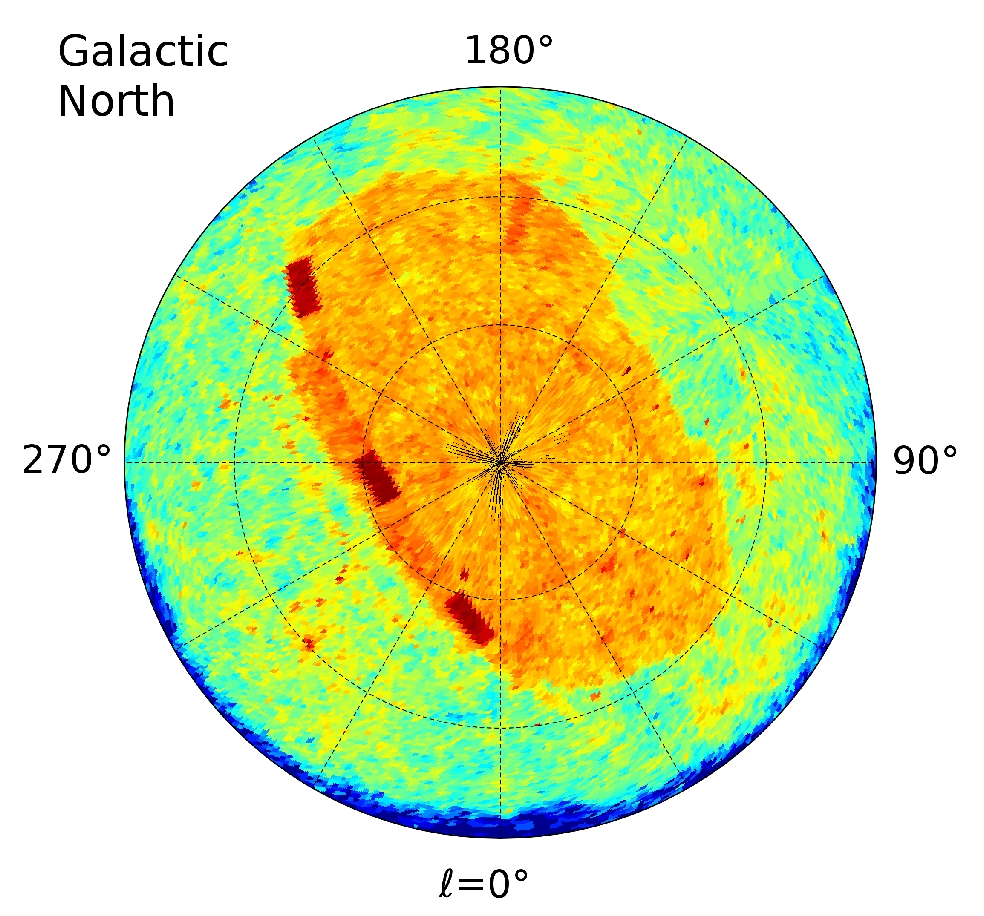
Searching for gravitational-wave counterparts with electromagnetic waves requires galaxy catalogs. Because we expect that the majority of gravitational-wave events should happen in the Universe where stuff exists, i.e., galaxies, having a galaxy catalog significantly increases the chances of finding a counterpart. Finding an electromagnetic counterpart reveals information that gravitational waves alone cannot provide. For example, GW170817 was observed in both gravitational waves and light, linking a neutron star merger to a short gamma-ray burst and providing evidence that these mergers produce heavy elements.
My collaborators and I produced GLADE, a galaxy catalog for multimessenger searches in the advanced gravitational-wave detector era. I contributed to this work by developing a statistical method to merge different smaller galaxy catalogs into a single, bigger catalog (GLADE). It is not straightforward to merge multiple galaxy catalogs into one because some of the entries in the catalogs may actually be referencing the same source. Hence a method that avoids duplicate entries is desirable.
The method I developed to merge different catalogs into one while avoiding duplicate entries relies on the fact that there are duplicate entries in galaxy catalogs. For example, we would expect different all-sky catalogs to observe M31 (one of the biggest and closest galaxies to us) and some other bright galaxies. By identifying objects with the same name between different galaxy catalogs, we can estimate the variance of various parameters between different galaxy catalogs. This allows us to select a contamination threshold. For example, a threshold of 0.99 corresponds to a missed-duplicate rate of 0.01 (1 − 0.99): 1% of duplicate entries are incorrectly treated as separate galaxies.
Read the paper in Monthly Notices of the Royal Astronomical Society .