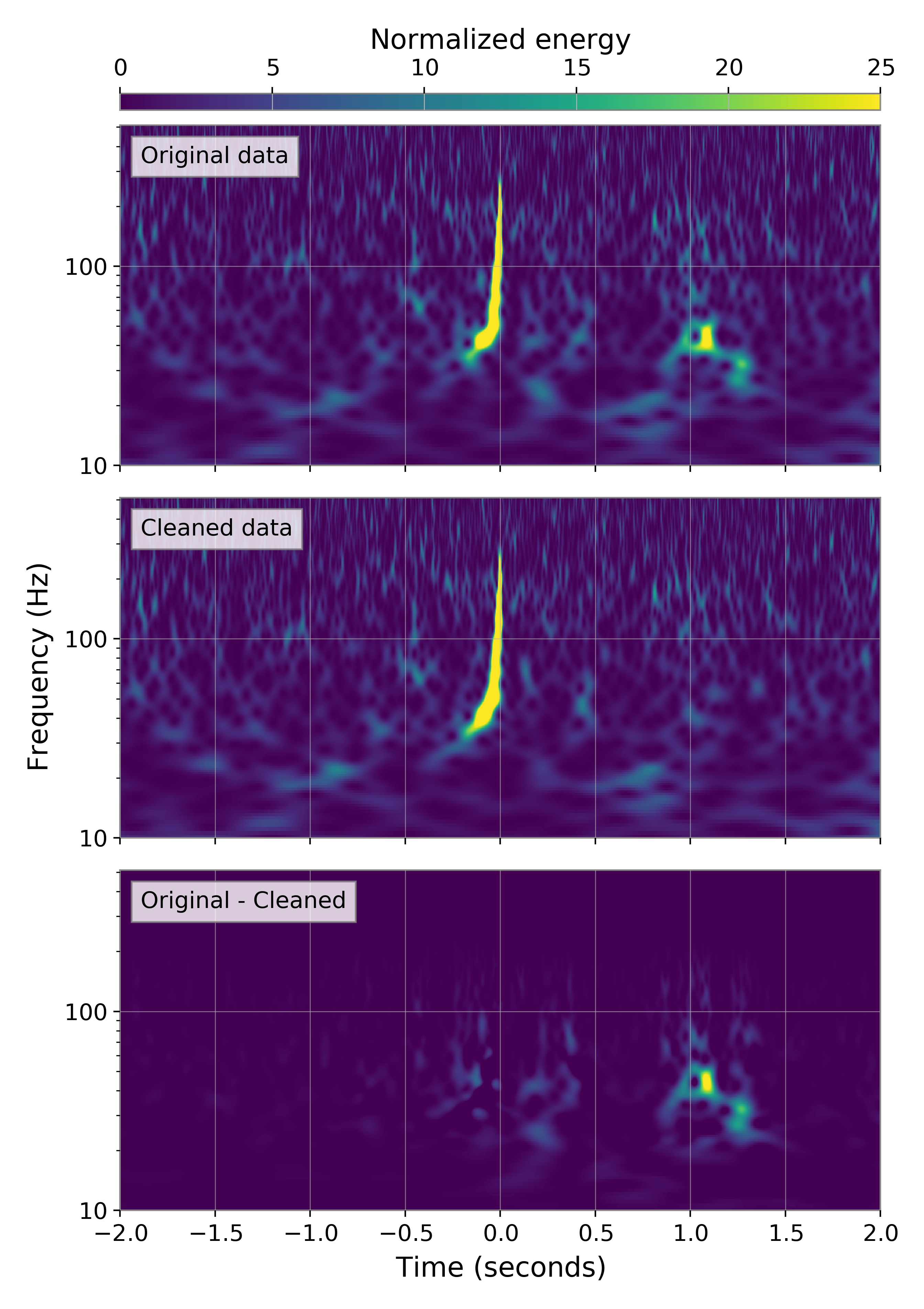
Gravitational-wave noise can sometimes overlap an astrophysical signal in the gravitational-wave data. A perfect example is a binary black hole merger GW200129 which overlapped with radio-frequency noise. This noise introduced additional uncertainty when estimating binary black hole parameters: by some estimates, the binary was not highly precessing, while other estimates indicated that this was the most strongly precessing binary black hole ever observed.
Luckily, the radio frequency noise was also recorded by witness channels, i.e. the channels that record only this particular noise but not the astrophysical signal. Our neural network reduced the noise more effectively than the method used by the LIGO–Virgo–KAGRA collaboration. Reanalyzing the cleaned data showed that evidence for precession remained.